Guided airway training

Quieter nights start with your airway

Airway Coach turns the muscles behind snoring — your tongue, soft palate and jaw — into something you can actually train. Five minutes a day, guided step by step.

iOS — coming soon

Educational exercises — not a diagnosis or treatment for sleep apnea. See our medical disclaimer below.

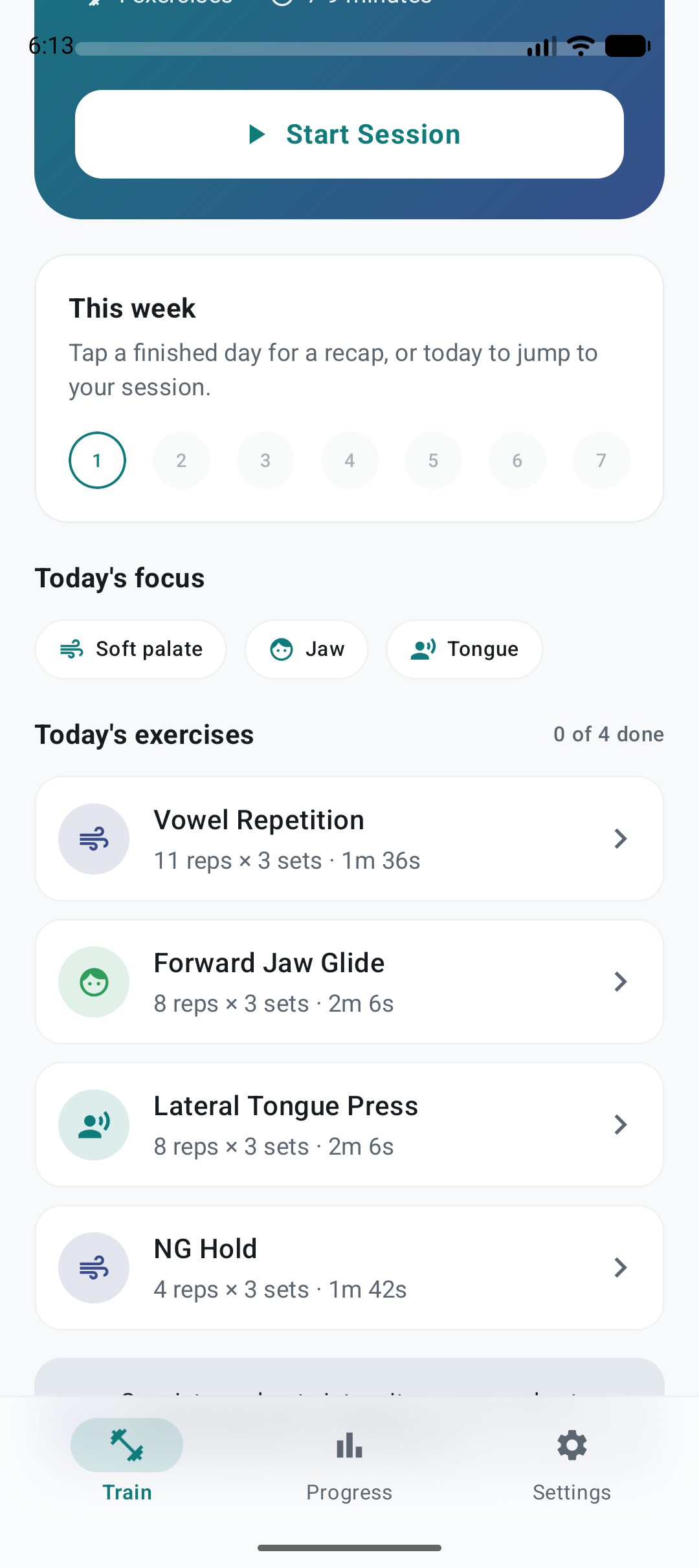
Airway Coach today's exercises screen
BEFOREAFTER

A stylized picture of the goal — not a device reading.

Where snoring starts

It's a muscle problem before it's a noise problem

During sleep, the muscles of your tongue, throat and soft palate relax. When they relax too far, the airway narrows and the surrounding tissue vibrates as air moves past it — that vibration is what you hear as snoring.

Airway Coach is built on a simple premise: like any other muscle group, this tissue responds to consistent, guided training.

Train the muscles. Change the sound they make.

Tissue, not machinery

The soft tissue around your airway behaves like any other muscle — it can be toned with repetition.

Consistency over intensity

Short, daily sessions are the format the exercises are designed around — not occasional long ones.

Everyone's baseline differs

Your plan adapts to your own starting point rather than a one-size routine.

The program

Four steps, five minutes a day

Airway Coach follows the same sequence every time you open it — assess, personalize, practice, track.

STEP 01

Assess

Answer a short questionnaire about your habits and sleep. An optional 20-second sound check can estimate a loudness baseline — entirely on your device.

STEP 02

Personalize

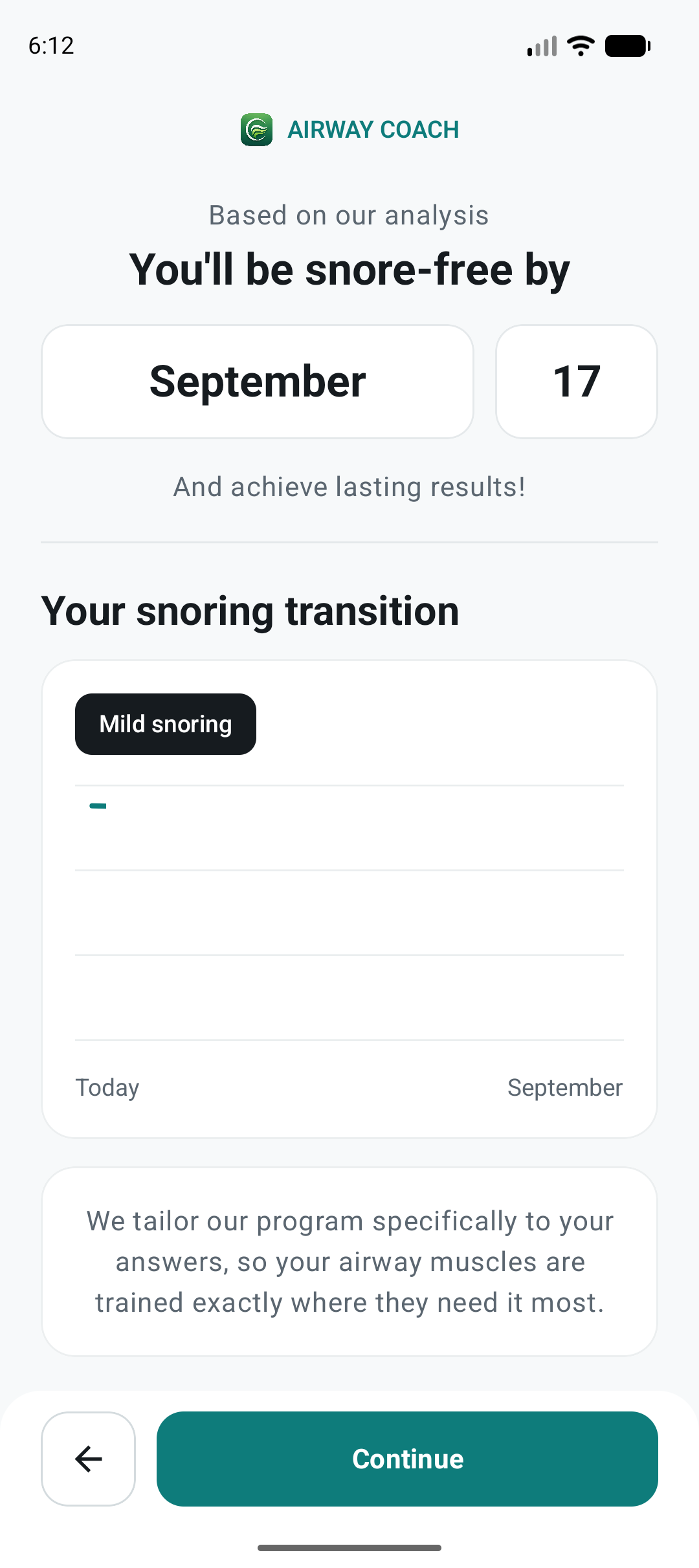
Your answers shape a plan that targets the muscle groups most relevant to you, at a pace that fits your day.

STEP 03

Practice

Follow guided animations for tongue, soft palate, jaw and cheek exercises — about five minutes, once a day.

STEP 04

Track

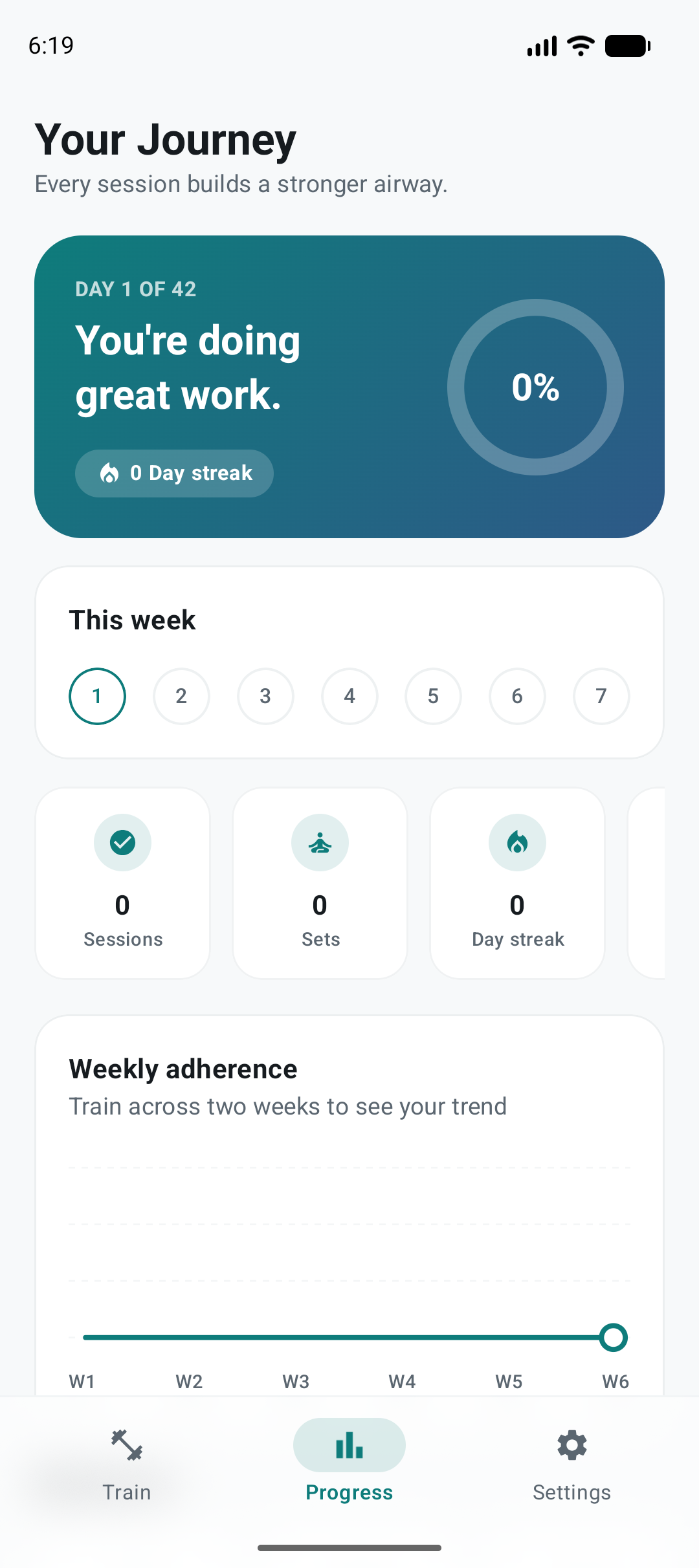
Reminders, streaks and a simple history keep the habit visible, so you can see the routine, not just hope it's working.

Train every muscle that matters

Five muscle groups, one routine

Each session rotates through the areas most involved in snoring, so no single muscle group gets left behind.

Tongue

Presses and glides that build tone across the base and tip of the tongue.

6 exercises

Soft palate

Vowel and hum sequences that engage the arch at the back of the mouth.

5 exercises

Jaw

Controlled opening and resistance moves that steady jaw positioning overnight.

4 exercises

Cheeks

Puff and hold sequences that support the muscles around the airway's opening.

4 exercises

Breathing

Nasal-breathing drills that build the habit a quieter airway depends on.

3 exercises
Built around the habit

Everything the routine needs, nothing it doesn't

The exercises do the work — these are the small things that keep you doing them.

Daily reminders

A single nudge at the time you choose — no noisy notification stream.

Streaks & history

See exactly which days you practiced, at a glance.

Personalized plans

Your routine is built from your own questionnaire, not a generic template.

Step-by-step animation

Every exercise is demonstrated visually, not just described in text.

Five-minute sessions

Designed to fit before bed, not to compete with it.

Your data stays yours

Erase everything stored on your device at any time, in one tap.

The reasoning behind it

Why airway exercises, and what they aren't

The exercises in Airway Coach draw on the same idea behind orofacial myofunctional practice: the tongue, soft palate, jaw and cheeks are muscles, and muscles respond to targeted, repeated movement.

Research referenced within the app is cited for educational context. Citing a study is not a claim that you will experience the same outcome — everyone's airway and starting point are different.

That's also why the app treats snoring as something to work on gradually, through a daily habit, rather than something a single session or a single app can fix overnight.

Medical disclaimer

Airway Coach is not a medical device and does not provide medical advice. The app offers educational content and guided exercises to support healthy breathing habits and general wellbeing.

It is not intended to diagnose, treat, cure or prevent any medical condition, including obstructive sleep apnea, and it does not measure, detect, or monitor any medical condition. The optional sound check estimates loudness only — it is not a diagnostic test.

Snoring can be a symptom of a serious medical condition. Please consult a qualified healthcare professional with any questions about a medical concern, and stop any exercise that causes pain or breathing difficulty.

Systematic review & meta-analysis

Pooling nine studies on oropharyngeal and tongue exercises, this review found reduced snoring in adults across both self-reported measures and overnight sleep-study recordings.

Camacho, Guilleminault, et al., Eur Arch Otorhinolaryngol, 2018 PubMed 29275425
Randomized controlled trial

In this three-month trial, the group doing daily oropharyngeal exercises showed a significantly lower objectively-measured snore index at the end of the study than the control group.

Ieto, Kayamori, et al., Chest, 2015 ScienceDirect
Cochrane review

This review found low-to-moderate certainty evidence that the exercises can reduce apnea-hypopnea events and daytime sleepiness, while noting the research base is still small and their effect on snoring frequency specifically remains uncertain.

Rueda, Mugueta-Aguinaga, et al., Cochrane Database Syst Rev, 2020 PubMed 33141943
These studies evaluated supervised, clinically-delivered myofunctional therapy programs in research settings — not the Airway Coach app itself, which has not been clinically tested. They're shared for educational context on the broader field, not as a claim about what this app will do for you. Individual results vary, and evidence quality ranges from low to moderate certainty across this body of research.
Available now on Android

Start training tonight

Airway Coach is live on Google Play — five minutes a day is all it takes to get started. iOS is on the way.

Get it on Google PlayiOS — Coming soon
Airway Coach personalized plan reveal screen
Questions

Before you ask

Will this treat my sleep apnea?+

No. Airway Coach is not intended to diagnose, treat, cure or prevent any medical condition, including obstructive sleep apnea, and it isn't a substitute for medical care. If you've been diagnosed with — or suspect you may have — sleep apnea, talk to a healthcare professional.

Is the sound check recording saved anywhere?+

No. The optional setup sound check is processed on your device as it happens. It's never saved to a file, uploaded, or shared — only a single loudness value is kept, on your device.

Do I need any equipment?+

No equipment — just your phone and a few quiet minutes. The sound check uses your phone's microphone, and it's entirely optional; you can skip it and build your plan from the questionnaire instead.

Is there research behind this?+

Yes — oropharyngeal and tongue exercises (myofunctional therapy) have been studied in several clinical trials and reviews, summarized with citations in The science section above. That research covers supervised programs in study settings, not the app itself, and results vary between studies and between people.

How is this different from a generic exercise video?+

Your plan is built from your own questionnaire (and optional sound check), then tracked over time with reminders and streaks — so the routine adapts to you instead of being a one-size list.

What does premium cost?+

Pricing, billing period, and any free trial length are shown on the purchase screen in your local currency before you confirm — monthly and annual options are available. Full terms are in our Terms of Use.

Can I delete my data?+

Yes — Settings → Delete all data removes everything the app has stored, immediately and irreversibly.